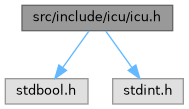
Interrupt Controller Unit (ICU) interface.
More...
#include <stdbool.h>
#include <stdint.h>
Go to the source code of this file.
|
| void | icu_init (const void *fdt) |
| | Initialize the interrupt controller unit.
|
| |
| bool | icu_register_irq (uint32_t irq_num, handler_data_t handler_data) |
| | Register a handler for a hardware interrupt source and enable it.
|
| |
| void | icu_unregister_irq (uint32_t irq_num) |
| | Unregister a handler for a hardware interrupt source and disable it.
|
| |
| void | icu_handle_irq (void) |
| | Top-level IRQ dispatch entry point.
|
| |
Interrupt Controller Unit (ICU) interface.
Provides declarations for early interrupt controller setup and simple interrupt management operations used by the kernel during bootstrap.
- Author
- Abhin Parekadan Jose
- Date
- 2026-06-07
◆ handler_data_t
Interrupt handler registration entry.
Pairs a handler function with its opaque private data pointer. Stored in the dispatch table indexed by INTID. When an interrupt fires, the dispatcher calls handler(private_data) for the corresponding entry.
◆ icu_handle_irq()
| void icu_handle_irq |
( |
void |
| ) |
|
Top-level IRQ dispatch entry point.
Called directly from the EL1 IRQ exception vector. Delegates to the GICv3 handler which acknowledges the interrupt via ICC_IAR1_EL1, dispatches based on INTID, and signals EOI via ICC_EOIR1_EL1.
This indirection layer allows the ICU (Interrupt Controller Unit) interface to remain decoupled from the underlying GIC implementation, making it straightforward to swap in a different interrupt controller without modifying the vector table or exception entry code.
◆ icu_init()
| void icu_init |
( |
const void * |
fdt | ) |
|
Initialize the interrupt controller unit.
Performs any platform-specific ICU startup required before the kernel can enable and service hardware interrupts.
- Parameters
-
| fdt | Pointer to the Flattened Device Tree (FDT) blob, which may be used to discover interrupt controller properties and configuration. |
◆ icu_register_irq()
| bool icu_register_irq |
( |
uint32_t |
irq_num, |
|
|
handler_data_t |
handler_data |
|
) |
| |
Register a handler for a hardware interrupt source and enable it.
- Parameters
-
| irq_num | Physical interrupt irq_num to register. |
| handler_data | Handler function and private data to register. |
- Returns
- true if the handler was registered and the interrupt enabled successfully, false if the irq_num is out of range or already registered.
◆ icu_unregister_irq()
| void icu_unregister_irq |
( |
uint32_t |
irq_num | ) |
|
Unregister a handler for a hardware interrupt source and disable it.
Disables the interrupt in the GIC and clears the corresponding entry in the dispatch table. After this call the irq_num will no longer fire and any previously registered handler will not be invoked.
- Parameters
-
| irq_num | Physical interrupt irq_num to unregister. |