Kernelite 0.1.0
Kernelite is a minimalist, educational operating system kernel built from scratch. The project aims to recreate core components of the Linux architecture to explore the fundamentals of operating system design and hardware-software interaction.
Loading...
Searching...
No Matches
Data Structures | Macros | Typedefs | Enumerations | Functions
page_table.h File Reference

Page table definitions and helpers for virtual memory mapping. More...

#include "fdt/fdt.h"
#include "linker/linker_defines.h"
#include "mem_layout/mem_layout.h"
#include <stdbool.h>
#include <stdint.h>
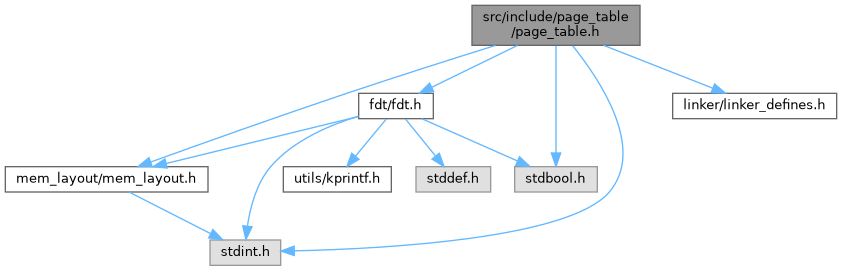
Include dependency graph for page_table.h:
This graph shows which files directly or indirectly include this file:

Go to the source code of this file.

Data Structures

struct  page_permissions_t
 Software representation of architectural page mapping privileges. More...
 
struct  table_desc_t
 TABLE DESCRIPTOR LAYOUT (Lookup levels 0, 1, or 2). More...
 
struct  page_desc_t
 FLAT BLOCK/PAGE DATA DESCRIPTOR LAYOUT — maps real physical memory. More...
 
union  page_table_entry_t
 Flat, architecturally stable AArch64 Stage 1 Descriptor structure. More...
 
struct  page_table_t
 Represents a single page table level (512 entries). More...
 

Macros

#define PAGE_SIZE   LINKER_PAGE_SIZE
 Size of each memory page in bytes.
 
#define PTRS_PER_TABLE   512
 Number of pointers per page table. from table D4-21 in the Armv8-A architecture reference manual.
 
#define NUM_PAGES(size)   (((size) + PAGE_SIZE - 1) / PAGE_SIZE)
 Calculate the number of pages needed for a given size.
 

Typedefs

typedef struct page_permissions_t page_permissions_t
 Software representation of architectural page mapping privileges.
 
typedef enum mem_type_t mem_type_t
 Memory type used as an index into the MAIR_EL1 register.
 
typedef struct table_desc_t table_desc_t
 TABLE DESCRIPTOR LAYOUT (Lookup levels 0, 1, or 2).
 
typedef struct page_desc_t page_desc_t
 FLAT BLOCK/PAGE DATA DESCRIPTOR LAYOUT — maps real physical memory.
 
typedef union page_table_entry_t page_table_entry_t
 Flat, architecturally stable AArch64 Stage 1 Descriptor structure.
 
typedef struct page_table_t page_table_t
 Represents a single page table level (512 entries).
 

Enumerations

enum  mem_type_t { DEVICE = 0 , NORMAL }
 Memory type used as an index into the MAIR_EL1 register. More...
 

Functions

bool map_page (page_table_t *root, virt_addr v_addr, phy_addr phy_addr, page_permissions_t perms, mem_type_t mem_typ)
 Map a virtual address to a physical address in the page table.
 
void dump_memory_map (page_table_t *root)
 Dump the memory map for debugging.
 
bool setup_kernel_id_map (phy_addr serial_device_addr_base)
 Set up the initial identity-mapped region for the kernel.
 
bool setup_kernel_map (memory_map_t *mmap)
 Set up the kernel's higher-half virtual-memory map.
 

Detailed Description

Page table definitions and helpers for virtual memory mapping.

Provides architecture-specific macros and declarations for building and manipulating page tables used by the kernel's memory management.

Author
Abhin Parekadan Jose
Date
2026-05-17

Typedef Documentation

◆ mem_type_t

typedef enum mem_type_t mem_type_t

Memory type used as an index into the MAIR_EL1 register.

The numeric value of each enumerator directly corresponds to the MAIR_EL1 attribute index encoded in page/block descriptor bits [4:2] (AttrIndx). The kernel must program MAIR_EL1 so that each index carries the correct attribute byte before the MMU is enabled.

◆ page_desc_t

typedef struct page_desc_t page_desc_t

FLAT BLOCK/PAGE DATA DESCRIPTOR LAYOUT — maps real physical memory.

Represents a 64-bit Stage 1 VMSAv8-64 block or page descriptor (4 KB granule) as defined in ARMv8/ARMv9 Architecture Reference Manual.

  • Level 1/2 block — bits[1:0] == 0b01, maps a 1 GB (L1) or 2 MB (L2) region.
  • Level 3 page — bits[1:0] == 0b11, maps a 4 KB page.

Lower attributes (bits [11:2]) control memory type, permissions, and shareability. The output address window (bits [49:12]) holds the physical frame address. Upper attributes (bits [63:50]) carry execution controls and feature extensions.

◆ page_permissions_t

Software representation of architectural page mapping privileges.

This tracking structure is used by the Virtual Memory Manager (VMM) to translate abstract software permissions down into raw ARM64 hardware bitfield constraints.

◆ page_table_entry_t

Flat, architecturally stable AArch64 Stage 1 Descriptor structure.

This union maps a standard 64-bit ARMv8/ARMv9 translation table descriptor. By avoiding nested internal anonymous unions and leveraging flattened structural representations, it guarantees exact 8-byte compilation across GCC and Clang toolchains without unintended alignment padding.

◆ table_desc_t

typedef struct table_desc_t table_desc_t

TABLE DESCRIPTOR LAYOUT (Lookup levels 0, 1, or 2).

Represents a 64-bit table descriptor as defined by ARMv8/ARMv9 VMSAv8-64 Table D8-50 (4 KB granule). A descriptor at levels 0–2 whose bits [1:0] == 0b11 points to the next-level page table whose base address is encoded in nlta_47_12 (and optionally the DS extension fields). Hierarchical permission fields in bits [63:59] propagate constraints down to every leaf reached through this table.

Enumeration Type Documentation

◆ mem_type_t

enum mem_type_t

Memory type used as an index into the MAIR_EL1 register.

The numeric value of each enumerator directly corresponds to the MAIR_EL1 attribute index encoded in page/block descriptor bits [4:2] (AttrIndx). The kernel must program MAIR_EL1 so that each index carries the correct attribute byte before the MMU is enabled.

Enumerator
DEVICE 

Index 0 — MAIR_EL1[7:0]: 0x00 Device-nGnRnE (non-gathering, non-reordering, no early write-ack).

NORMAL 

Index 1 — MAIR_EL1[15:8]: 0xFF Normal Inner/Outer Write-Back Read/Write-Allocate Cacheable.

Function Documentation

◆ dump_memory_map()

void dump_memory_map ( page_table_t root)

Dump the memory map for debugging.

Parameters
rootPointer to the root page table to dump.

◆ map_page()

bool map_page ( page_table_t root,
virt_addr  v_addr,
phy_addr  phy_addr,
page_permissions_t  perms,
mem_type_t  mem_typ 
)

Map a virtual address to a physical address in the page table.

Walks the four-level (L0→L3) translation table rooted at root, allocating intermediate table descriptors as needed, and installs a leaf page descriptor at L3 that covers the 4 KB page containing v_addr. The descriptor's AttrIndx field is set from mem_typ, selecting the matching MAIR_EL1 slot (see mem_type_t).

Parameters
rootPointer to the root (L0) page table. Must not be NULL.
v_addrVirtual address to map; only bits [47:12] are significant (the 4 KB page base — lower bits are ignored).
phy_addrPhysical address of the target frame; must be 4 KB-aligned.
permsSoftware permission flags (page_permissions_t) that are translated into the AP[2:1], PXN, and UXN hardware fields.
mem_typMemory type index (mem_type_t) written into AttrIndx[2:0] of the leaf descriptor, selecting the MAIR_EL1 attribute byte (e.g. DEVICE → 0x00 Device-nGnRnE, NORMAL → 0xFF Normal WB-RWA Cacheable).
Returns
true Mapping installed successfully.
false root was NULL, v_addr/phy_addr were not 4 KB aligned, or allocation of an intermediate table failed.

◆ setup_kernel_id_map()

bool setup_kernel_id_map ( phy_addr  serial_device_addr_base)

Set up the initial identity-mapped region for the kernel.

Creates the early page-table mappings needed during low-virtual-address boot, including the serial-device mapping used by the early console.

Parameters
serial_device_addr_basePhysical base address of the serial device to map during early boot.
Returns
true on success, false on failure such as an allocation error or invalid mapping setup.

◆ setup_kernel_map()

bool setup_kernel_map ( memory_map_t mmap)

Set up the kernel's higher-half virtual-memory map.

Maps every region described by mmap into the higher half, giving pages within the kernel image RWX permissions and all other pages RW.

Parameters
mmapPointer to the memory map structure describing the available physical-memory regions.
Returns
true on success, false on failure such as an empty memory map, an allocation error, or an invalid mapping configuration.